
“The concept of ’honest sound’ perfectly encapsulates these loudspeakers’ essence”
Please meet Amphion user: audio and video production professional, British expat Nick Clegg, his 7.1.4 Amphion-powered Yokohama studio, and film projects in the Orient.
Yokohama, Japan – From the rolling hillsides of Accrington in Lancashire, UK, to establishing a new business venture in the major port city of Yokohama in Kanagawa, Japan, English musician and recording engineer – Nick Clegg – talks to us about his start-up in the music industry, business-entry into the Orient, and a recent movie project released in time for the Japanese summer. It’s challenging to do the sound on any movie project, but to be tasked with covering all the sound-capture, editing, and creating in one project is on another level. Nick, with his 7.1.4 Amphion room at Sound Factory Yokohama, along with his wife and business-partner Miho Abe as sound producer, achieved just that for the globally-famous 東宝株式会社 | Toho Co. Ltd and its digital content label Gemstone for the fourth instalment in its Gemnibus series – フレイル (“Frail”) – directed by Mabuta Motoki, a pioneer of vertical cinema and Grand Prix winner at the 75th Cannes Film Festival. Also included with this interview is a special-feature (in Japanese) on Nick and his studio recently released by one of Japan’s most prominent pro-audio dealers – Rock oN Company.
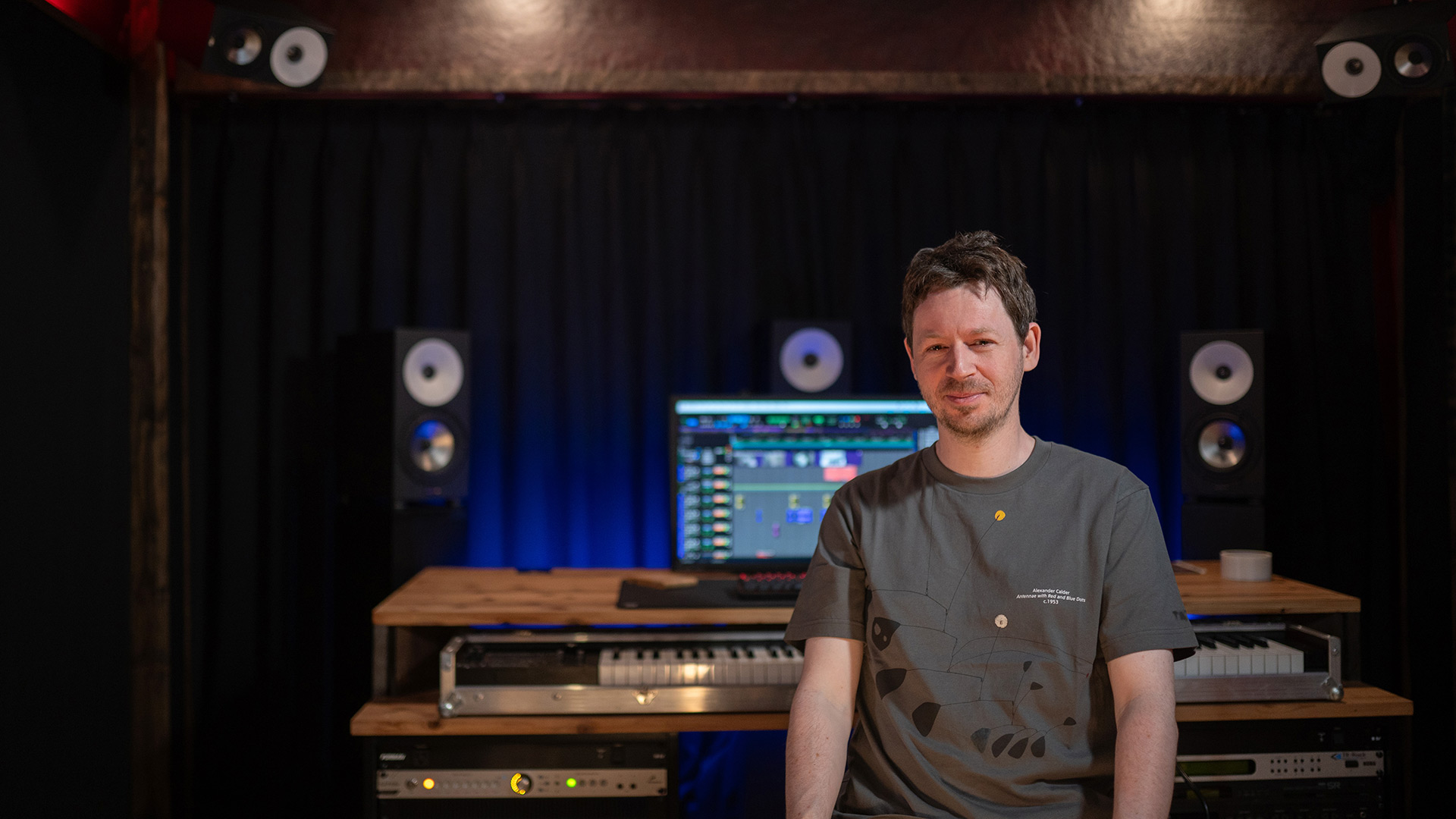
A composer, performer, mixing engineer, and sound designer … When did you embark on your music career, where did you get your start in the music business, who were your main influencers and industry mentors, and what brought you to work in Japan?
My music journey began at a young age, when I started playing keyboards with local bands, performing both original compositions and cover songs. Back then, my focus was solely on performing, and I had little knowledge of sound or mix engineering. It wasn’t until I entered music college where one of my subjects was recording that I became interested. After college, my interest in recording continued to grow. I decided to pursue engineering studies at university, where I had access to a studio. This provided me with the opportunity to start recording bands in a professional setting.
Eventually, this experience inspired me to establish my own music production studio at home in the UK. A little later, now some 12 years ago, my wife, who is Japanese, and I made the decision to relocate to Japan. Her business was already established in Japan, and I was eager to experience life outside of the UK. My entry into the production and post-production industry began when I moved here. In my first expat year, I started working freelance for a production company, thanks to a connection through a friend of my wife.
Since 2017, the configuration of Sound Factory has moved from stereo to immersive. What was the original stereo studio setup, and what gear line-up (console, racks, mics etc) and plugins are you running now?
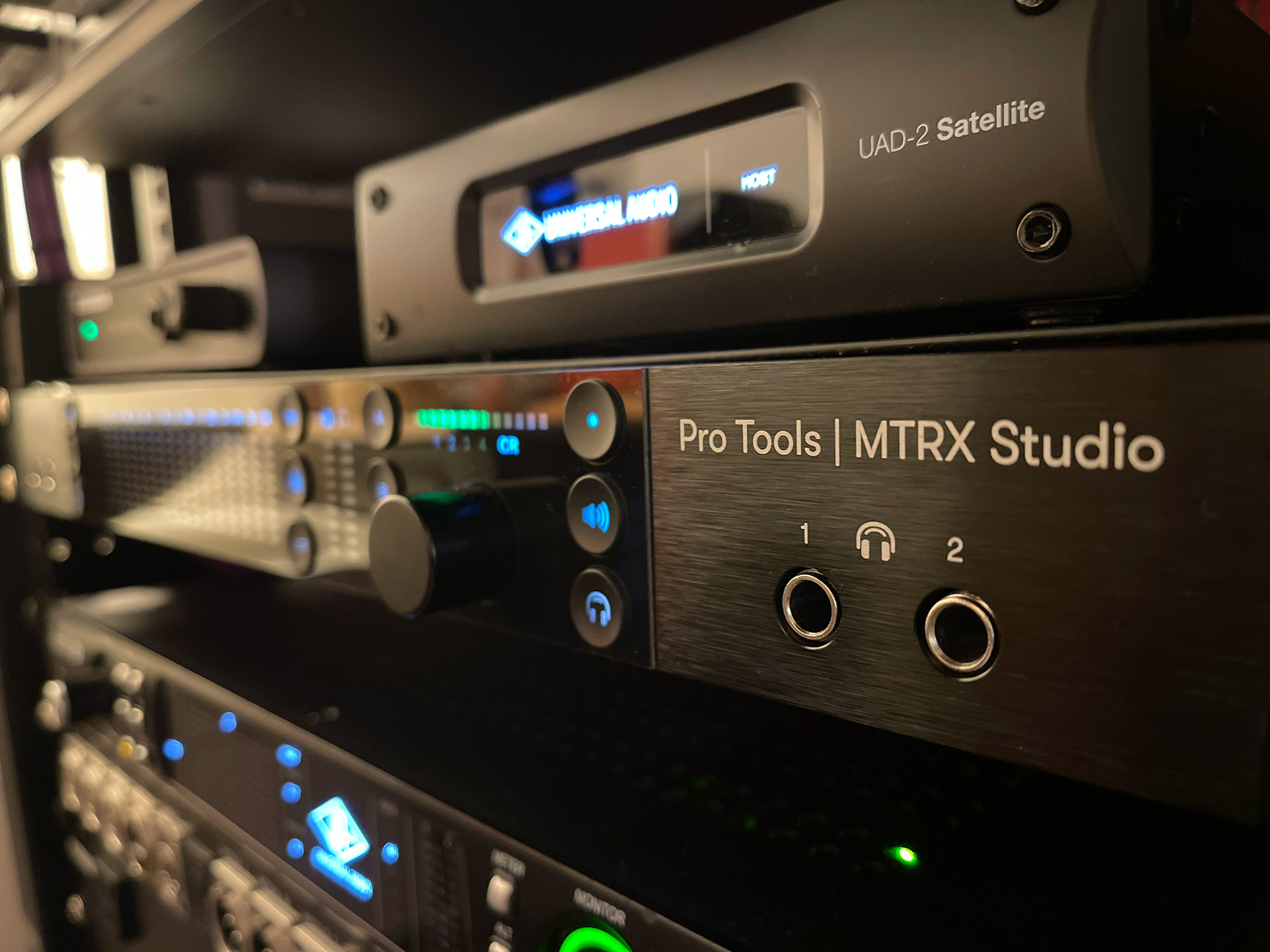
My original stereo setup consists of One18 monitors powered by an Amp700, through a Universal Audio Apollo 8 interface using an Antelope Satori monitor controller. The only recent addition to the stereo setup is the FlexBase25 system, which has really enhanced our monitoring capabilities. As for the studio itself, it was primarily designed with mixing in mind. While we do some recording here, especially when we’re producing music or working on voiceovers and ADR, the main focus has always been on creating an optimal environment for mixing and composing. When it comes to recording, composing, and mixing music in stereo, I use the Universal Audio Apollo 8 interface.
For vocals, I prefer running them through the Universal Audio LA-610 – it just gives them that extra warmth and richness. As for instruments, I have a couple of routes. Sometimes I’ll run them through the SSL Alpha VHD pre, but other times I’ll go straight into the Apollo and use its unison preamps. For mics, I swear by my Neumann U87ai – it’s my go-to for vocals and even some acoustic instruments. Recently, I even used it to capture most of the foley for a film project.
For processing, I rely heavily on UAD plug-ins, also I love using FabFilter for EQ and Reverb. For composing, I have a mix of virtual instruments and hardware synths. Among my go-to virtual instruments are Spitfire Audio sample instruments, including BBC Symphony Orchestra Professional and Hans Zimmer Percussion. Lately, I’ve been using some of the new Crow Hill Sample instruments. Additionally, I rely on selections from Arturia, Korg, and Spectrasonics.
Now 11 years in Japan, are there any especially memorable projects you have worked with during this time and you’d like to share with us?
Moving to Japan was a big step for me, and it definitely came with its challenges, especially since I didn’t speak any Japanese. But I dove into various projects and connected with a production company that specialized in overseas productions. From handling location recording to providing PA services for events, I took on various roles. Over time, however, people I collaborated with began to understand my true passion, and they introduced me to individuals who could help further my career aspirations. Fast forward just over a decade, and I’m finally getting into film post-production and composition. My aim moving forward is to forge connections with more talented film producers and artists in the industry.
One of the projects I’m particularly proud of is my recent work on a short film for Toho. I handled everything from the production sound recording to sound design, foley, ADR, and 5.1 mix – basically, everything except the music! Being involved from the start of the project until its completion allowed me to provide a higher level of service. Having an understanding of the scene from the location, I was able to anticipate the director’s vision as soon as I received the locked picture. By that point, we had developed a solid rapport, which made the collaborative process incredibly smooth. The director particularly appreciated the modular synth sounds we created for the VFX.
I think that what sets me apart is my dual role as both a composer and engineer. It allows me to view projects from both creative and technical perspectives, which can be invaluable in the music and film industry.
Amphions are your choice of monitors and base systems. How did you discover the brand and what have you found are their real merits? How do you find the claims of “no ear fatigue”, “unsurpassed clarity”, and “exceptional translation” often related to Amphion monitors?
A friend recommended Amphion monitors to me, and I had the opportunity to listen to them at the Red Bull Studios. What struck me was the clarity of the sound and the absence of any distinct personality in the monitors. The concept of “honest sound” perfectly encapsulates these loudspeakers’ essence. They’re engineered to deliver audio without adding any coloration or bias, allowing for the most natural reproduction of sound. Editing with these monitors is an immensely satisfying experience because they faithfully reproduce the captured audio.
I remember meeting Amphion’s founder Anssi Hyvönen and playing him one of my compositions – mixed on my previous monitors. His response, “good guess,” highlighted the uncertainty I faced with my old setup. With Amphion, however, I no longer have to rely on guesswork. Whether it’s composing, mixing, or working on 5.1 film sound in my studio, I can trust that the sound translates accurately across different environments. It’s made my workflow much smoother, especially when comparing my mixes in larger dubbing studios.
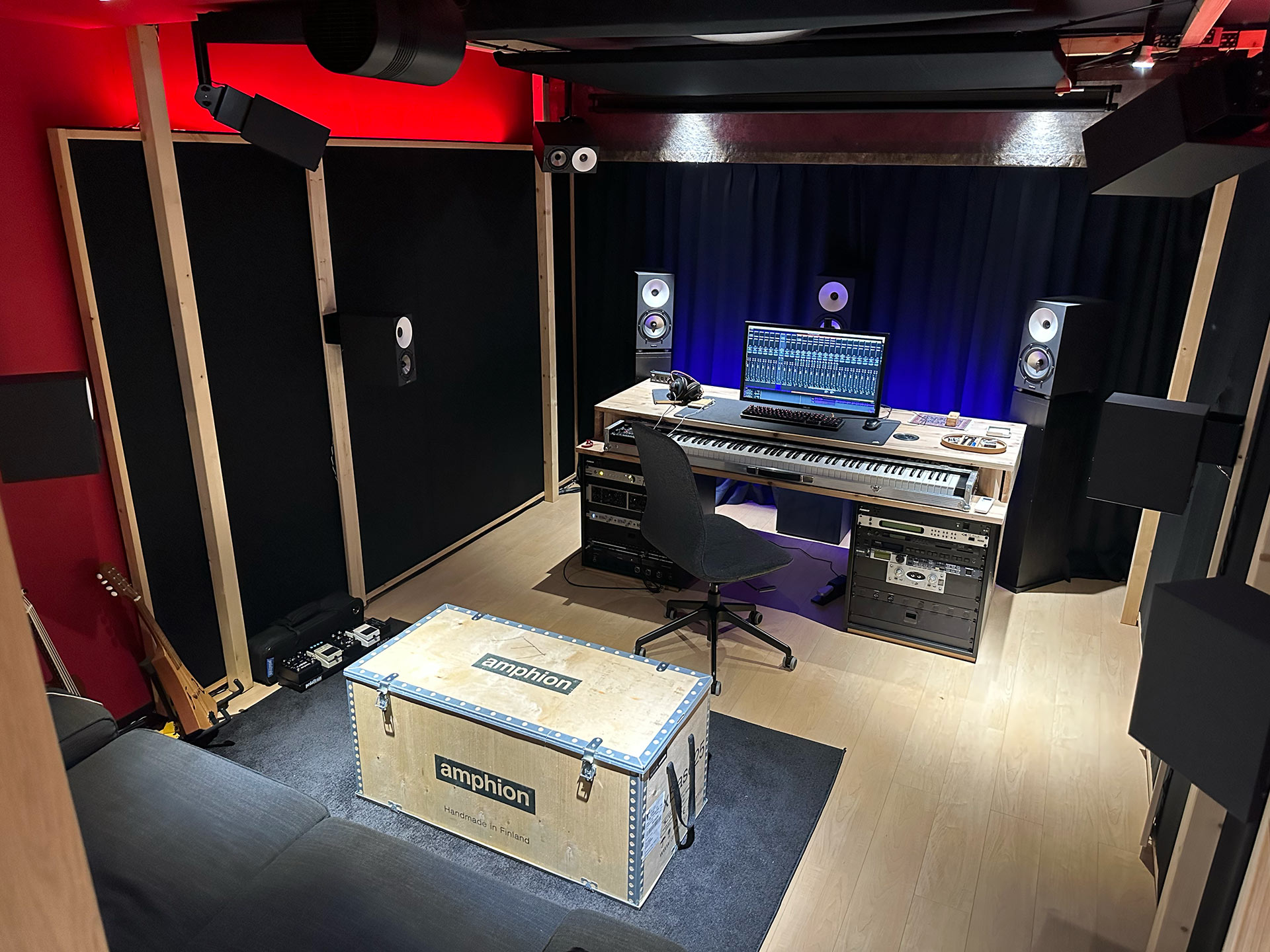
When did you open your immersive 7.1.4 Dolby Atmos Music Studio? Did you design and build the space yourself? What’s included in the set-up ? Were there any challenges you faced in the build?
Earlier this year, I reopened the studio after completing its construction, which was quite challenging due to the global gear shortage caused by COVID-19. I had to search for alternatives for some pieces that were out of stock. When working in 5.1 or ATMOS, I switch over to the AVID MTRX Studio and send the signal out to the Amphion amps. My Amphion setup consists of One18s for the LCR, One12s for the surround and height, and the FlexBase25 system for the sub/LFE. I utilize two Amp700s and an Amp400.8 for the amplification.
Are there any major projects in the pipeline that you can share with us? And what sort of sonic projects are you keen to move into? Apart from artist original releases or artist remixes into spatial audio, what other opportunities do you see for immersive audio?
We are moving towards more film work – offering “movie | sound” services. At the moment we are working on an indie film – sound design and composition, as well as music-mix and theatre 5.1. We’ve met more filmmakers as a result of the Toho project. Also, we will expand on delivering immersive Dolby Atmos mixes for streaming platforms like Apple TV and Netflix to fully utilize our 7.1.4 Amphion-powered facility.
For more information on Sound Factory Yokohama
For Japanese readers, go here for the Rock oN Company Feature
For more information on Amphion Immersive Audio